MELEC · Electrical trades
Vocational English for the electrical workshop and site · clear wording for regular class.
Corresponds to: building and industrial electrical systems and automation
Vocational English for the electrical workshop and site · clear wording for regular class.
Corresponds to: building and industrial electrical systems and automation
Corresponds to: building and industrial electrical systems and automation
| Term | Phrase in context |
|---|---|
| lock-out | “I lock out the breaker and put my tag on it.” |
| voltage tester | “I check for zero voltage with the tester, then I check again.” |
| PPE | “Helmet, insulating gloves and safety shoes: full PPE.” |
| work order | “The work order shows the room, the circuit and the deadline.” |
| single-line diagram | “I compare the single-line diagram with the real wiring.” |
| breaker | “I switch off the main breaker before any work.” |
| customer call-out | “This is a customer call-out: lighting is down in room T2.” |
| handover | “Before handover, I explain what I did and what remains.” |
| risk | “If I skip the test, the risk is an electric shock.” |
| instruction | “Read the safety instruction before you open the panel.” |
How it works · read each row as a real situation. Column 1 = what you (electrical apprentice) may do. Column 2 = what you must not do. Column 3 = What the qualified electrician does (the qualified adult / mentor). Then the I know / I don’t know tables: if you don’t know · you ask. These tables are also your written record to copy into the notebook.
Madame Carole Paoli Pompougnac · CFA Production
| I can… | I must not… | What the qualified electrician does |
|---|---|---|
| Wear full PPE (helmet, gloves, safety shoes) and check it before entering | Work live or “just take a quick look” inside an open panel | Locks out / unlocks according to authorisation and signs the record |
| Prepare the tools listed on the work order and keep them ready | Open alone a switchboard I do not know | Identifies the circuit on the single-line diagram, then opens under procedure |
| Ask out loud for a voltage test before any contact | Lend my padlock or remove a lock that is not mine | Applies the named lock-out (padlock + tag) and removes it |
| Read the instruction and restate what I understood to the team | Confirm “immediate danger” to the customer without a check | Reports controlled facts to the customer / supervisor |
| Keep the area tidy and say “I’m not sure” · I ask | Improvise a repair outside the work order | Decides the technical next step and validates my action |
| I can… | I must not… | What the qualified electrician does |
|---|---|---|
| Set up the bay (tools, tested voltage tester, PPE) from the workshop sheet | Skip a step on the safety sheet “to go faster” | Validates the procedure and authorises the start of the exercise |
| Follow the projected diagram and tick each check on my sheet | Touch a live training setup “just to see” | Performs / supervises insulation tests and final checks |
| Say clearly: “I can do X; for Y I need a check” | Boast (“I can do everything”) or stay silent when I don’t know | Corrects, explains the trade gesture and sets my autonomy limit |
| Copy the record (date · room · checks · visa) into my notebook | Sign a record for a classmate or invent a check | Signs as the responsible person and archives the sheet |
| Tidy and restore the bay after the class | Leave a cable or tool out of place “for next time” | Checks the bay and clears non-conformities |
| Situation | I know | I don’t know · I ask |
|---|---|---|
| Before opening a panel on site | I know I need PPE + work order + instruction read | I don’t know which circuit · I ask the mentor |
| After isolation | I know I need a voltage test + re-test before contact | I don’t know where to measure · I ask to be shown |
| Facing an alarming customer message | I know how to sort fact / opinion / rumour | I confirm nothing without a check · I tell the pro |
| If my padlock is already used elsewhere | I know I never lend my padlock | I don’t know the unlock procedure · I ask |
| Situation | I know | I don’t know · I ask |
|---|---|---|
| At the start of the bay exercise | I know how to read the workshop safety sheet step by step | A step is unclear · I raise my hand before acting |
| During training wiring | I know how to compare diagram and wiring with power off | A wire doesn’t match · I stop and ask |
| For the written record | I know how to note date, room, checks, my visa | I don’t know which check to tick · I ask before signing |
| End of class | I know how to tidy and report what is missing | I don’t know if the bay is OK · I get it checked |
Focus question · How do you read a workplace instruction in electrical workshop / site and pass it on without losing a critical step?
Support type · Authentic-style trade document (invented, realistic)
Guided questions (Socratic reading) ·
In vocational English (BO special No. 5 / 11-04-2019), learners work on everyday and workplace situations. At CAP level the target is roughly CECRL A2; Bac Pro LVA aims toward B1+. This learning journey trains reading for action: spotting steps, bans, and conditions in a electrical workshop / site document, then passing the information on orally and in a short written note. Core idea · accuracy before speed; if you are unsure, you ask.
BO / CECRL aim · Reading comprehension (BO LV) · CECRL written reception
Language aims · Scan for who / what / order / forbidden actions.
Timing
Core activity · Guided reading for action (BO LV reception).
Worked table · read columns I can · I must not · What the qualified worker does. If you don’t know · you ask.
| I can… | I must not… | What the qualified electrician does |
|---|---|---|
| Wear full PPE (helmet, gloves, safety shoes) and check it before entering | Work live or “just take a quick look” inside an open panel | Locks out / unlocks according to authorisation and signs the record |
| Prepare the tools listed on the work order and keep them ready | Open alone a switchboard I do not know | Identifies the circuit on the single-line diagram, then opens under procedure |
| Ask out loud for a voltage test before any contact | Lend my padlock or remove a lock that is not mine | Applies the named lock-out (padlock + tag) and removes it |
| Read the instruction and restate what I understood to the team | Confirm “immediate danger” to the customer without a check | Reports controlled facts to the customer / supervisor |
| Keep the area tidy and say “I’m not sure” · I ask | Improvise a repair outside the work order | Decides the technical next step and validates my action |
Copy the blank table · your own example from placement / CFA
| I can… | I must not… | What the qualified electrician does |
|---|---|---|
| … | … | … |
| … | … | … |
| … | … | … |
| … | … | … |
| … | … | … |
Materials · Trade sheet + step cards
At home · after class 1 · Copy the 6-step chain. Circle 5 words to keep.
BO / CECRL aim · Spoken production (BO LV) · CECRL oral production
Language aims · Explain the procedure in your own words (90 sec).
Timing
Core activity · Spoken production / interaction (BO LV).
Worked table · read columns I can · I must not · What the qualified worker does. If you don’t know · you ask.
| I can… | I must not… | What the qualified electrician does |
|---|---|---|
| Set up the bay (tools, tested voltage tester, PPE) from the workshop sheet | Skip a step on the safety sheet “to go faster” | Validates the procedure and authorises the start of the exercise |
| Follow the projected diagram and tick each check on my sheet | Touch a live training setup “just to see” | Performs / supervises insulation tests and final checks |
| Say clearly: “I can do X; for Y I need a check” | Boast (“I can do everything”) or stay silent when I don’t know | Corrects, explains the trade gesture and sets my autonomy limit |
| Copy the record (date · room · checks · visa) into my notebook | Sign a record for a classmate or invent a check | Signs as the responsible person and archives the sheet |
| Tidy and restore the bay after the class | Leave a cable or tool out of place “for next time” | Checks the bay and clears non-conformities |
Copy the blank table · your own example from placement / CFA
| I can… | I must not… | What the qualified electrician does |
|---|---|---|
| … | … | … |
| … | … | … |
| … | … | … |
| … | … | … |
| … | … | … |
Materials · Criteria grid + timer
At home · after class 2 · Record 90 seconds on your phone; note one miss.
BO / CECRL aim · Spoken interaction (BO LV) · CECRL interaction
Language aims · Ask clear questions when something is missing or unclear.
Timing
Core activity · Spoken interaction: ask / clarify (BO LV).
Worked table · read columns I can · I must not · What the qualified worker does. If you don’t know · you ask.
| Situation | I know | I don’t know · I ask |
|---|---|---|
| Before opening a panel on site | I know I need PPE + work order + instruction read | I don’t know which circuit · I ask the mentor |
| After isolation | I know I need a voltage test + re-test before contact | I don’t know where to measure · I ask to be shown |
| Facing an alarming customer message | I know how to sort fact / opinion / rumour | I confirm nothing without a check · I tell the pro |
| If my padlock is already used elsewhere | I know I never lend my padlock | I don’t know the unlock procedure · I ask |
| Situation | I know | I don’t know · I ask |
|---|---|---|
| At the start of the bay exercise | I know how to read the workshop safety sheet step by step | A step is unclear · I raise my hand before acting |
| During training wiring | I know how to compare diagram and wiring with power off | A wire doesn’t match · I stop and ask |
| For the written record | I know how to note date, room, checks, my visa | I don’t know which check to tick · I ask before signing |
| End of class | I know how to tidy and report what is missing | I don’t know if the bay is OK · I get it checked |
Copy the blank table · your own example from placement / CFA
| Situation | I know | I don’t know · I ask |
|---|---|---|
| … | … | … |
| … | … | … |
| … | … | … |
| … | … | … |
| Situation | I know | I don’t know · I ask |
|---|---|---|
| … | … | … |
| … | … | … |
| … | … | … |
| … | … | … |
Materials · Situation cards + stem bank
At home · after class 3 · Write 3 questions you could ask tomorrow on placement.
BO / CECRL aim · Writing (BO LV) · CECRL written production
Language aims · Produce a dated 8 · 12 line note: actions + checks.
Timing
Core activity · Writing a short organised text (BO LV).
Worked table · read columns I can · I must not · What the qualified worker does. If you don’t know · you ask.
| I can… | I must not… | What the qualified electrician does |
|---|---|---|
| Wear full PPE (helmet, gloves, safety shoes) and check it before entering | Work live or “just take a quick look” inside an open panel | Locks out / unlocks according to authorisation and signs the record |
| Prepare the tools listed on the work order and keep them ready | Open alone a switchboard I do not know | Identifies the circuit on the single-line diagram, then opens under procedure |
| Ask out loud for a voltage test before any contact | Lend my padlock or remove a lock that is not mine | Applies the named lock-out (padlock + tag) and removes it |
| Read the instruction and restate what I understood to the team | Confirm “immediate danger” to the customer without a check | Reports controlled facts to the customer / supervisor |
| Keep the area tidy and say “I’m not sure” · I ask | Improvise a repair outside the work order | Decides the technical next step and validates my action |
| I can… | I must not… | What the qualified electrician does |
|---|---|---|
| Set up the bay (tools, tested voltage tester, PPE) from the workshop sheet | Skip a step on the safety sheet “to go faster” | Validates the procedure and authorises the start of the exercise |
| Follow the projected diagram and tick each check on my sheet | Touch a live training setup “just to see” | Performs / supervises insulation tests and final checks |
| Say clearly: “I can do X; for Y I need a check” | Boast (“I can do everything”) or stay silent when I don’t know | Corrects, explains the trade gesture and sets my autonomy limit |
| Copy the record (date · room · checks · visa) into my notebook | Sign a record for a classmate or invent a check | Signs as the responsible person and archives the sheet |
| Tidy and restore the bay after the class | Leave a cable or tool out of place “for next time” | Checks the bay and clears non-conformities |
Copy the blank table · your own example from placement / CFA
| I can… | I must not… | What the qualified electrician does |
|---|---|---|
| … | … | … |
| … | … | … |
| … | … | … |
| … | … | … |
| … | … | … |
| I can… | I must not… | What the qualified electrician does |
|---|---|---|
| … | … | … |
| … | … | … |
| … | … | … |
| … | … | … |
| … | … | … |
Materials · Gapped model + checklist
At home · after class 4 · Rewrite a clean version; fix 3 language points marked in class.
BO / CECRL aim · Spoken production (BO LV) · CECRL oral production
Language aims · Link gesture and language on the trade floor (or simulation).
Timing
Core activity · Oral language in a simulated workplace (co-teaching).
Worked table · read columns I can · I must not · What the qualified worker does. If you don’t know · you ask.
| Situation | I know | I don’t know · I ask |
|---|---|---|
| Before opening a panel on site | I know I need PPE + work order + instruction read | I don’t know which circuit · I ask the mentor |
| After isolation | I know I need a voltage test + re-test before contact | I don’t know where to measure · I ask to be shown |
| Facing an alarming customer message | I know how to sort fact / opinion / rumour | I confirm nothing without a check · I tell the pro |
| If my padlock is already used elsewhere | I know I never lend my padlock | I don’t know the unlock procedure · I ask |
| Situation | I know | I don’t know · I ask |
|---|---|---|
| At the start of the bay exercise | I know how to read the workshop safety sheet step by step | A step is unclear · I raise my hand before acting |
| During training wiring | I know how to compare diagram and wiring with power off | A wire doesn’t match · I stop and ask |
| For the written record | I know how to note date, room, checks, my visa | I don’t know which check to tick · I ask before signing |
| End of class | I know how to tidy and report what is missing | I don’t know if the bay is OK · I get it checked |
Copy the blank table · your own example from placement / CFA
| Situation | I know | I don’t know · I ask |
|---|---|---|
| … | … | … |
| … | … | … |
| … | … | … |
| … | … | … |
| Situation | I know | I don’t know · I ask |
|---|---|---|
| … | … | … |
| … | … | … |
| … | … | … |
| … | … | … |
Materials · Floor / props + phrase frame
At home · after class 5 · Prepare 5 “While I… I say…” lines for the next learning journey.
Focus question · How do you ask, clarify and explain clearly with a client or electrical mentor without freezing or inventing?
Support type · Dialogue / ticket / client brief (authentic style)
Guided questions (Socratic reading) ·
Spoken interaction is central in BO LV vocational English: greeting, asking, clarifying, explaining, closing. In electrical workshop / site, the electrical apprentice must manage register (polite, clear) and repair strategies (“Sorry, could you repeat…?”, “Do you mean…?”). This learning journey builds short, reusable turns for real CFA placements toward CECRL A2 / B1+.
BO / CECRL aim · Listening / reading for action (BO LV) · CECRL reception
Language aims · Identify opening / question / explanation / closing moves.
Timing
Core activity · Reception + noticing interaction patterns.
Limits reminder · before you act on information, check what you may / must not do.
| I can… | I must not… | What the qualified electrician does |
|---|---|---|
| Wear full PPE (helmet, gloves, safety shoes) and check it before entering | Work live or “just take a quick look” inside an open panel | Locks out / unlocks according to authorisation and signs the record |
| Prepare the tools listed on the work order and keep them ready | Open alone a switchboard I do not know | Identifies the circuit on the single-line diagram, then opens under procedure |
| Ask out loud for a voltage test before any contact | Lend my padlock or remove a lock that is not mine | Applies the named lock-out (padlock + tag) and removes it |
| Read the instruction and restate what I understood to the team | Confirm “immediate danger” to the customer without a check | Reports controlled facts to the customer / supervisor |
| Keep the area tidy and say “I’m not sure” · I ask | Improvise a repair outside the work order | Decides the technical next step and validates my action |
Copy the blank table · your own example from placement / CFA
| I can… | I must not… | What the qualified electrician does |
|---|---|---|
| … | … | … |
| … | … | … |
| … | … | … |
| … | … | … |
| … | … | … |
Materials · Situation card + phrase bank
At home · after class 1 · Learn 6 bank phrases; be ready to use 3 in Class 2.
BO / CECRL aim · Spoken interaction (BO LV) · CECRL interaction
Language aims · Run Q&A turns with repair language.
Timing
Core activity · Spoken interaction (BO LV).
Materials · Info-gap cards
At home · after class 2 · Write a 6-line dialogue using 2 repair stems.
BO / CECRL aim · Spoken production (BO LV) · CECRL oral production
Language aims · Explain one trade step to a non-specialist.
Timing
Core activity · Spoken production adapted to the listener.
Materials · Two model explanations
At home · after class 3 · Rewrite your explanation in 8 lines for a customer / patient.
BO / CECRL aim · Writing (BO LV) · CECRL written production
Language aims · Email / SMS / ticket note after the interaction.
Timing
Core activity · Writing for a workplace recipient (BO LV).
Materials · Message frame
At home · after class 4 · Rewrite for a different recipient (mentor ↔ customer).
BO / CECRL aim · Spoken interaction (BO LV) · CECRL interaction
Language aims · 4-minute role-play + 5-line written trace.
Timing
Core activity · Integrated interaction + writing.
Materials · Cue cards + grid
At home · after class 5 · File your grid; note 2 goals for the next learning journey.
Focus question · How do you present your trade and describe a real task clearly for a mobility or exam-style oral?
Support type · Task photo / short mobility brief + outline
Guided questions (Socratic reading) ·
Presenting the trade links language learning with vocational identity and mobility (BO LV). Learners structure a short oral and a parallel written text: present · describe a task · reflect on a difficulty · project a mobility or improvement goal. This supports CAP A2 / Bac Pro B1+ exam-style performance without empty slogans.
BO / CECRL aim · Writing (BO LV) · CECRL written production
Language aims · Collect facts and useful sentences about the trade.
Timing
Core activity · Reading outline + writing a short ID text.
Materials · Outline + interview sheet
At home · after class 1 · Finish the ID paragraph; learn it aloud.
BO / CECRL aim · Spoken production (BO LV) · CECRL oral production
Language aims · Oral description with sequencing markers.
Timing
Core activity · Spoken production with cohesion.
Materials · Sequencing board + timer
At home · after class 2 · Write the 5 steps with at least 3 markers.
BO / CECRL aim · Spoken interaction (BO LV) · CECRL interaction
Language aims · Talk about a problem and a future placement wish.
Timing
Core activity · Interaction + soft argumentation.
Materials · Model + mobility prompts
At home · after class 3 · Write 8 lines: difficulty + mobility wish.
BO / CECRL aim · Writing (BO LV) · CECRL written production
Language aims · 12 · 15 lines matching the oral structure.
Timing
Core activity · Writing organised text (BO LV).
Materials · Paragraph frame
At home · after class 4 · Final clean copy for the portfolio.
BO / CECRL aim · Spoken production (BO LV) · CECRL oral production
Language aims · 2 · 3 min presentation + 2 questions (formative).
Timing
Core activity · Integrated oral assessment (BO LV / CECRL).
Materials · Outline + criteria grid
At home · after class 5 · Store recording or notes; list 3 phrases for real mobility.
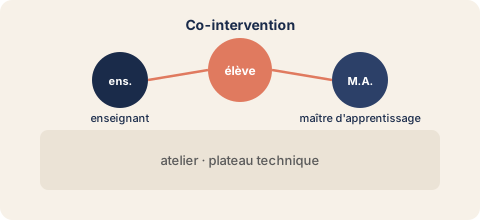
On the floor (co-teaching) · use the table to say limits, read the instruction, write the record.
| I can… | I must not… | What the qualified electrician does |
|---|---|---|
| Wear full PPE (helmet, gloves, safety shoes) and check it before entering | Work live or “just take a quick look” inside an open panel | Locks out / unlocks according to authorisation and signs the record |
| Prepare the tools listed on the work order and keep them ready | Open alone a switchboard I do not know | Identifies the circuit on the single-line diagram, then opens under procedure |
| Ask out loud for a voltage test before any contact | Lend my padlock or remove a lock that is not mine | Applies the named lock-out (padlock + tag) and removes it |
| Read the instruction and restate what I understood to the team | Confirm “immediate danger” to the customer without a check | Reports controlled facts to the customer / supervisor |
| Keep the area tidy and say “I’m not sure” · I ask | Improvise a repair outside the work order | Decides the technical next step and validates my action |
| I can… | I must not… | What the qualified electrician does |
|---|---|---|
| Set up the bay (tools, tested voltage tester, PPE) from the workshop sheet | Skip a step on the safety sheet “to go faster” | Validates the procedure and authorises the start of the exercise |
| Follow the projected diagram and tick each check on my sheet | Touch a live training setup “just to see” | Performs / supervises insulation tests and final checks |
| Say clearly: “I can do X; for Y I need a check” | Boast (“I can do everything”) or stay silent when I don’t know | Corrects, explains the trade gesture and sets my autonomy limit |
| Copy the record (date · room · checks · visa) into my notebook | Sign a record for a classmate or invent a check | Signs as the responsible person and archives the sheet |
| Tidy and restore the bay after the class | Leave a cable or tool out of place “for next time” | Checks the bay and clears non-conformities |
Core trade document (also used across learning journeys).
Homework linked to the three learning journeys and trade documents · mid-journey and end-of-journey tasks.
Type · Short writing + prepared speaking
Duration · 45 min + 2 min speaking
Brief · From the trade sheet (safety sheet AT-MELEC-SEC-12 / work order), write 8 · 12 lines restating the procedure for a beginner in electrical workshop / site. Then prepare a 2-minute oral: order of actions + one ban. Audience · electrical mentor or a classmate. BO LV / CECRL · reading for action + spoken production (A2 / toward B1+).
Trade support · safety sheet AT-MELEC-SEC-12 / work order
Success criteria · /20
| Criterion | Marks |
|---|---|
| Accurate understanding of the document | 4 |
| Clear organisation (order of actions) | 3 |
| Trade lexis in sentences | 3 |
| Speaking: volume, clarity, no critical miss | 5 |
| Language care | 5 |
| Total | /20 |
Type · Dialogue write-up + role-play prep
Duration · 55 min
Brief · Write a 10 · 12 line workplace dialogue (greet · clarify · explain · close) set in electrical workshop / site. Then practise aloud. Include 2 repair stems (“Could you repeat…?”, “Do you mean…?”). BO LV · spoken interaction + writing.
Trade support · Situation linked to: lock-out, wiring, voltage check, reading a diagram
Success criteria · /20
| Criterion | Marks |
|---|---|
| Complete interaction moves | 5 |
| Clear clarifying questions | 4 |
| Register adapted to listener | 4 |
| Repair language present | 3 |
| Language care | 4 |
| Total | /20 |
Type · Oral outline + parallel short text
Duration · Prep 40 min · oral 2 · 3 min
Brief · Prepare a 2 · 3 minute presentation of your trade and one task in electrical workshop / site, plus a mobility wish or improvement goal. Write a parallel 12 · 15 line text. BO LV / CECRL · spoken production + writing (A2 / B1+).
Trade support · Mobility outline + placement notebook
Success criteria · /20
| Criterion | Marks |
|---|---|
| Clear trade / task description | 5 |
| Sequencing markers | 3 |
| Mobility / improvement part present | 4 |
| Parallel writing quality | 4 |
| Language care | 4 |
| Total | /20 |
Formative assessment (criteria grid) and CFA-style summative assessment (speaking + writing), aligned with BO LV / CECRL A2 · B1+.
Type · Formative criteria grid
Duration · 15 · 20 min observation during a class
Brief · During an activity in electrical workshop / site (or simulation), the teacher completes a grid: reception · interaction · production · writing. Oral feedback + 3 improvement tips.
Grading · grid /10 (indicative)
Marking scheme · /10
| Criterion | Marks |
|---|---|
| Reception · finds key info in the document | 2 |
| Interaction · asks / clarifies | 2 |
| Production · explains a step clearly | 2 |
| Writing · dated readable trace | 2 |
| Attitude · asks rather than invents | 2 |
| Total | /10 |
Type · Summative (5 min speaking + 40 min writing)
Duration · about 1 hour
Brief · Writing · from an extract of safety sheet AT-MELEC-SEC-12 / work order: 3 comprehension questions + 8 · 12 line message for electrical mentor + 8 lines presenting one task. Speaking · 5 minutes: instruction handoff + one interaction repair. Aligned with BO LV / CECRL A2 · B1+.
Grading · mark /20 (summative)
Marking scheme · /20
| Criterion | Marks |
|---|---|
| Reading / comprehension | 4 |
| Workplace message | 4 |
| Task presentation writing | 4 |
| Speaking (handoff + interaction) | 5 |
| Language and attitude | 3 |
| Total | /20 |
Brief · Write a placement report linking trade gestures (lock-out, wiring, voltage check, reading a diagram) with vocational English. Use your weekly log. Audience: English teacher + electrical mentor.
Indicative length · 6 to 10 pages (CAP / Bac Pro) · readable font 12 · 1.5 spacing
Report structure
Success criteria · /20
| Criterion | Marks |
|---|---|
| Complete outline | 4 |
| Accurate trade facts | 4 |
| Analysis (not only description) | 4 |
| Language and presentation | 4 |
| Clear English ↔ trade link | 4 |
| Total | /20 |
Each week in electrical workshop / site, log one task, one term, one sentence. Examples below.
| Day | Task done | Lexis kept | Sentence to keep |
|---|---|---|---|
| Monday | … | lock-out | Today I used “lock-out” in a real situation. |
| Tuesday | … | voltage tester | Sentence kept from electrical mentor. |
| Wednesday | … | breaker | I will restate this for a classmate tomorrow. |
| Thursday | … | … | … |
| Friday | … | … | … |
Duration · 5 to 8 minutes + questions
Plan (5 · 8 min)
Criteria · /20
| Criterion | Marks |
|---|---|
| Clarity and structure | 5 |
| Accurate trade lexis | 5 |
| Interaction / answers | 5 |
| Professional attitude | 5 |
| Total | /20 |
Type · Authentic-style CFA sheet (reading for action · CECRL A2 · B1+)
CFA Production · pedagogical sheet
Comprehension questions ·
Brief · Complete each sentence with the right term: lock-out, voltage tester, breaker, PPE, single-line diagram. Setting · electrical workshop / site.
Brief · Turn casual speech into clear workplace English for a notice in the electrical workshop / site. Use imperatives, must / have to, and sequencing markers (first, then, finally).
Brief · From one situation in the electrical workshop / site (lock-out, wiring, voltage check, reading a diagram), write three short versions: a) inform (facts) · b) clarify with a repair question · c) present the task (6 · 8 lines).
Brief · In 3 · 5 minutes, present one task in the electrical workshop / site (lock-out, wiring, voltage check, reading a diagram): what you read, what you say, what you write. Include 3 terms: lock-out, voltage tester, breaker. CECRL · spoken production A2 / toward B1+.
Duration · 3 · 5 min + 1 · 2 min questions
Expected outline
Criteria · /20
| Criterion | Marks |
|---|---|
| Clarity and timing | 4 |
| Accurate trade lexis | 5 |
| Read · speak · write link | 4 |
| Interaction (answers) | 4 |
| Professional attitude | 3 |
| Total | /20 |
Model expectations · Learner sets a scene in the electrical workshop / site, names the electrical mentor, refers to safety sheet AT-MELEC-SEC-12 / work order, uses lock-out, voltage tester, breaker in sentences, shows reading, speaking and writing moves, and answers without inventing unsafe steps.
Use the outline above. Below is about one page of métier-specific model text with teacher annotations. Learners adapt facts and wording · no copy-paste.
Teaching annotations ·
Type · Writing + speaking (task + markscheme + model answers)
Duration · ≈ 1 hour
Task ·
Markscheme · /20
| Criterion | Marks |
|---|---|
| Q1 · Facts / instruction | 4 |
| Q2 · Workplace message | 6 |
| Q3 · Task presentation writing | 5 |
| Speaking · handoff + answer | 5 |
| Total | /20 |